



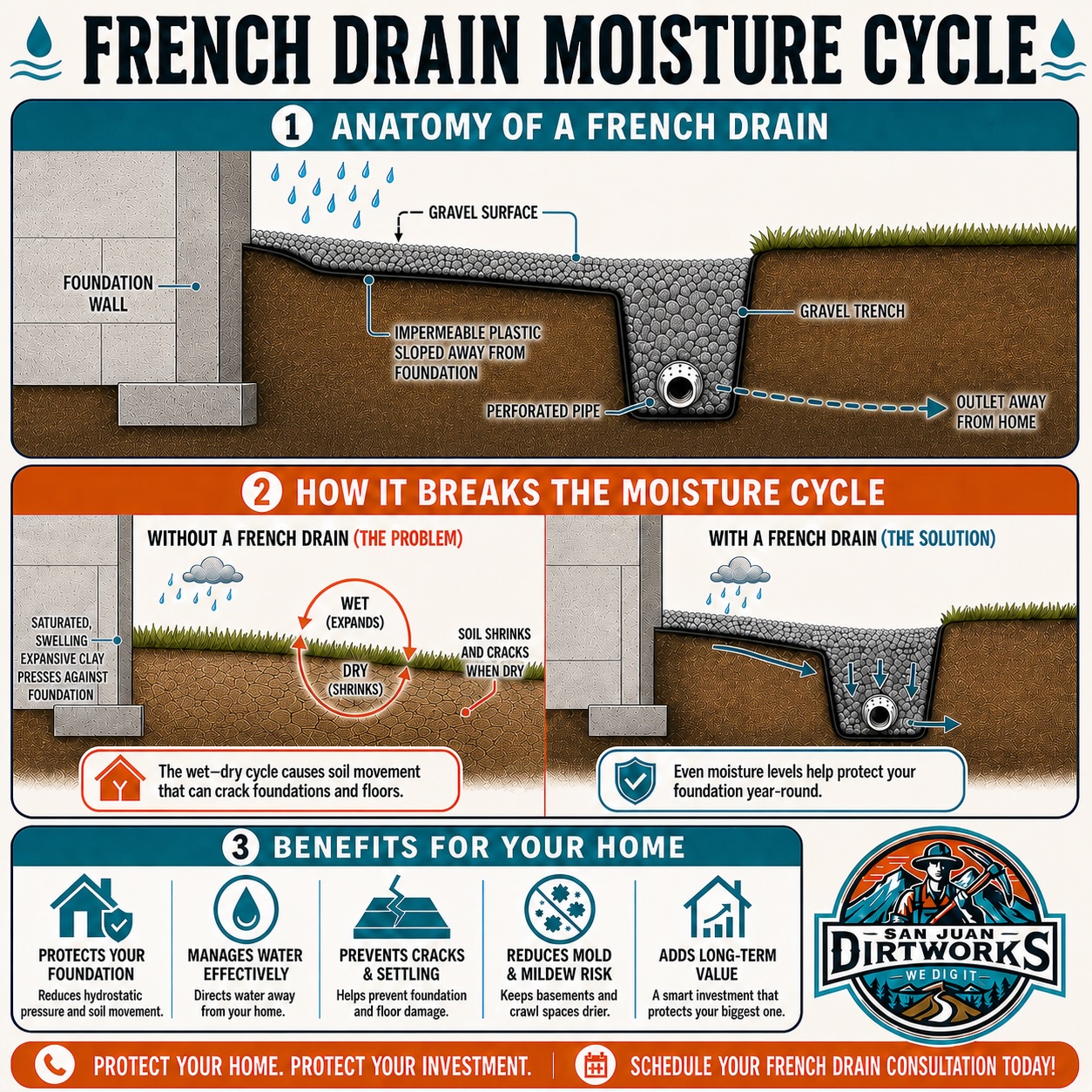
If you own a home in Archuleta County, you live on soils that can move more than you might expect. Certain local clays swell when they get wet and shrink when they dry out. That constant movement shows up as cracks in slabs, sticky doors, and bowed or leaning foundation walls.
The most active area is often right along the “drip line” of your roof—the strip of ground that takes the brunt of rain and snowmelt. That’s exactly where a properly designed French drain can break the moisture cycle and help protect your foundation.
What Is a French Drain?
A French drain is a simple subsurface drainage system designed to collect water from the surface and shallow soils and move it away from your home.
In the infographic above, you can see the basic components:
- A shallow trench set a short distance away from the foundation
- An impermeable plastic layer on top of the soil, sloped gently away from the wall
- A layer of clean gravel on top of that plastic
- A perforated drain pipe buried in gravel inside the trench
- An outlet where the collected water can safely discharge downhill
Water lands on the gravel surface, flows across the sloped plastic into the trench, drops into the gravel and pipe, and is carried away from the structure.
Why Expansive Soils Are So Hard on Foundations
Expansive clays don’t just get wet—they actually change volume. When they absorb water, they swell and push against anything in their way. When they dry out, they shrink and can leave voids under slabs and footings.
Near a typical foundation, that wet–dry cycle is driven by:
- Roof runoff that concentrates water along the drip line
- Snow piles and spring snowmelt soaking the same area
- Summer storms that add another round of moisture
Over time, this causes repeated up‑and‑down and in‑and‑out movement along your foundation. That’s when you start to see:
- Cracks in basement or crawlspace walls
- Uneven or heaving concrete flatwork
- Gaps opening between walls, ceilings, and floors
How a French Drain Breaks the Moisture Cycle
The goal is not to “waterproof the world,” but to control where water goes around your home. A French drain helps in three key ways:
- Keeps water out of the most sensitive zone
Instead of letting water soak straight down right next to the foundation, the sloped plastic and gravel surface redirect runoff into the trench. This keeps the soil right along the wall from cycling between very wet and very dry. - Gives water a preferred path away from the house
The gravel trench and perforated pipe act like a highway for water. When it rains or snow melts, water has an easy route to follow—into the trench, into the pipe, and out to a safe discharge point. - Reduces soil movement and pressure on the structure
By evening out moisture levels in the soil near the wall, the drain helps reduce swelling and shrinking of expansive clay. That means less pushing on your foundation and less risk of cracking and long‑term movement.
The “with drain” side of the infographic shows this clearly: the soil around the footing stays lighter and more uniform, while the water is visibly diverted into the drain system instead of building up against the wall.
Signs You Might Need Better Drainage
A French drain is not the answer to every problem, but it’s an important tool in the toolbox for expansive soils. It may be worth a closer look if you’re noticing:
- Seasonal cracks that open and close in foundations or interior drywall
- Driveways, patios, or walkways lifting or settling near the house
- Persistent dampness or standing water along one side of the home
- A visible low spot or “trough” under the roof drip line where water collects
If you see one or more of these and know you’re on clayey soils, drainage is often a smart place to start.
Why Work with a Local Contractor
French drains look simple, but details matter:
- How far from the foundation the trench should be
- How deep to place the pipe
- Where and how to daylight or connect the outlet
- How to integrate with gutters, downspouts, and existing grading
- Local freeze–thaw and snowmelt patterns that affect performance
In Archuleta County, a local crew that understands expansive soils and steep, snowy sites can design a system that fits your specific home, not just a generic diagram.
Ready to Break the Moisture Cycle?
If you’re concerned about cracks, uneven slabs, or long‑term movement around your home, a French drain can be a practical, cost‑effective way to get water under control before it becomes a major structural issue.
Use the infographic above as a guide, then consider having your site evaluated so you get a drainage plan that matches your soils, slopes, and structures.
If you tell a bit about your website platform (WordPress, Squarespace, etc.), the next step can be tailoring this draft into an exact format—headline length, excerpt, image alt text, and a short social caption—to match how you’ll publish it.